
What is a prairie?
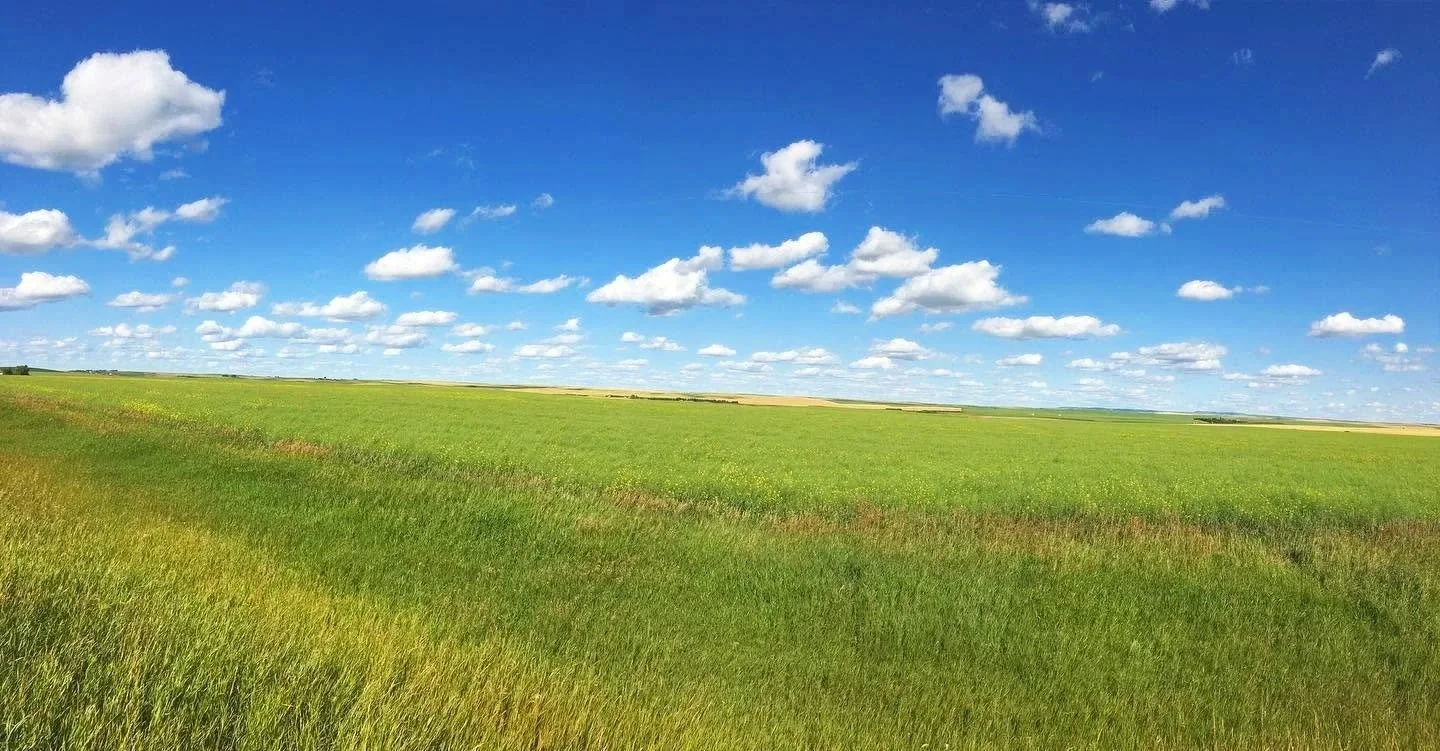
Alberta fields, west of Drumheller. Photo by Shara Cooper
If you’ve ever read Little House on the Prairie, chances are your first image of a prairie is the one painted by Laura Ingalls Wilder who describes “the enormous, empty prairie,” stretching beneath an endless blue sky, where grasses ripple like waves and the horizon seems to go on forever. Her prairie stretches north from the American Midwest into southern Manitoba, where the same sweeping grasslands continue unassumingly across an international border.
But here in Canada, “the Prairies” means something more. Yes, it’s a landscape — native grasslands, wheat fields, coulees, aspen parkland, and skies so vast they seem to dwarf everything beneath them. But it’s also a region, a culture, and, for many of us, an identity. To say you grew up “on the Prairies” tells people something about where you’re from — but also something about who you are.
As someone who was born and raised here, I am not objective. The Prairies are part of my family story. They shaped my grandma, my mom, and me too. This land is a big part of how I keep them with me.
I’ve stood in mountain ranges that made me feel inconsequential and beside oceans that took my breath away, but nowhere has ever felt quite like home. Out here, the horizon opens something in you. The sky feels bigger, the air feels lighter, and if you ever forget to breathe, don’t worry — the prairie wind will happily do it for you.
So what is a prairie? In Canada, the answer is twofold: an ecological region and a cultural one.
First is the ecological definition. A prairie is a native temperate grassland, an ecosystem shaped by grasses, wildflowers, grazing animals, fire, weather, soil, and climate rather than forests. While many people picture a sea of grass stretching to the horizon, a healthy prairie is astonishingly diverse. Hundreds of species of grasses and flowering plants can thrive in a single prairie, creating habitat for birds, pollinators, mammals, reptiles, and countless insects.
In Canada, ecologists recognize several distinct prairie ecosystems, each with its own character. Tallgrass prairie, found primarily in southern Manitoba, is lush and incredibly species-rich. Mixed-grass prairie, which stretches across southern Saskatchewan and Alberta, is the iconic prairie landscape many Canadians know best. Fescue prairie, found in cooler, slightly wetter areas near the foothills, is another uniquely Canadian prairie community. Although they look different from one another, they’re all prairie.
Then there’s the second meaning. Ask a Canadian where “the Prairies” are, and chances are they’ll point to Manitoba, Saskatchewan, and Alberta. Notice the capital P. In Canada, the Prairies aren’t just ecosystems — they’re a connected region. It’s shorthand for the Prairie provinces, even though not every part of those provinces is actually native prairie. The Rocky Mountains, boreal forests, parklands, lakes, the Canadian Shield and even the Hudson Bay are all parts of this region. The grasslands that gave the region its name are concentrated mostly in the southern reaches of all three provinces.
The word prairie arrives in English through French. In French, prairie simply means “meadow” — an open stretch of land covered in grass or low vegetation, often near water or in a clearing. It comes from Old French, and ultimately from the Latin pratum, meaning “meadow” or “grassland.” When French explorers and fur traders moved through North America in the 17th and 18th centuries, they encountered vast stretches of treeless grassland unlike the forests they were more accustomed to in eastern regions. Lacking a better term, they used prairie to describe these open landscapes.
Over time, the word stuck. What began as a simple French word for meadow became the name for one of the defining ecological regions of North America — and, in Canada especially, something much larger than just a type of land.
This is one of those distinctions that looks subtle from the outside, but matters a great deal in how the words are actually used. In Canada, you will almost always hear the word prairie. In the United States, you will more commonly hear Great Plains. At a glance they describe similar kinds of landscapes — vast, open regions with relatively few trees — but the words carry different weight and different usage traditions.
Prairie is the ecological term used in Canada for native grassland ecosystems. It refers to a specific kind of biome shaped by grasses, fire, grazing, climate, and soil. Canadian ecologists regularly speak about tallgrass prairie, mixed-grass prairie, and fescue prairie as distinct ecological communities.
One of the most common misunderstandings about prairie is that it is uniform — nothing but endless grass. In reality, Canadian prairie is a mosaic of distinct ecosystems, each shaped by subtle differences in moisture, temperature, soil, and elevation.
Today, the rarest of these is tallgrass prairie, found primarily in southern Manitoba. This is the lushest form of prairie in Canada, once covering vast areas but now reduced to less than 1% of its original extent. Tallgrass prairie is dense, rich in plant diversity, and historically maintained through a combination of fire and grazing. In its untouched form, the grasses can grow so high and thick that movement through it is difficult — something early settlers noted with a mix of awe and unease. It is the kind of landscape that appears in early frontier writing as something almost enclosing, rather than simply open.
Moving west, the dominant ecosystem becomes mixed-grass prairie, which stretches across much of Saskatchewan and into parts of Alberta. This is the prairie most Canadians picture: rolling grasslands, shifting between taller and shorter species depending on rainfall and soil conditions. It is resilient, adapted to a variable climate, and forms much of the agricultural and ranching backbone of the Prairies today.
Further west and into higher elevations, particularly near the foothills of the Rocky Mountains in southern Alberta, you encounter fescue prairie. Cooler and generally wetter than the grasslands to the east, fescue prairie is characterized by dense, tufted grasses and a different plant community altogether. It often blends gradually into parkland and forest, marking the transition between open prairie and the rising land of the mountains. Taken together, these prairie types form a continuum rather than a set of isolated categories.
And that is part of what makes prairie so easy to underestimate.
In Canada, it is estimated that 80% of natural prairie has disappeared. What was once a continuous ecological system stretching across vast interior landscapes has been broken into fragments, reshaped by agriculture, settlement, and cultivation over the past two centuries. Prairie soil, once broken and turned, is among the most productive farmland in the world. Wheat, canola, and other crops transformed the grasslands into one of the great agricultural regions of the planet. Towns and roads followed. Fields replaced native grasses. The transformation was rapid, and in many places, nearly complete.
In Canada today, that world has not disappeared entirely. Grasslands National Park in southern Saskatchewan protects some of the most intact remaining mixed-grass prairie in the country, preserving both landscape and species that exist nowhere else in abundance. The Tall Grass Prairie Preserve in Manitoba safeguards rare fragments of the most endangered prairie ecosystem in Canada.
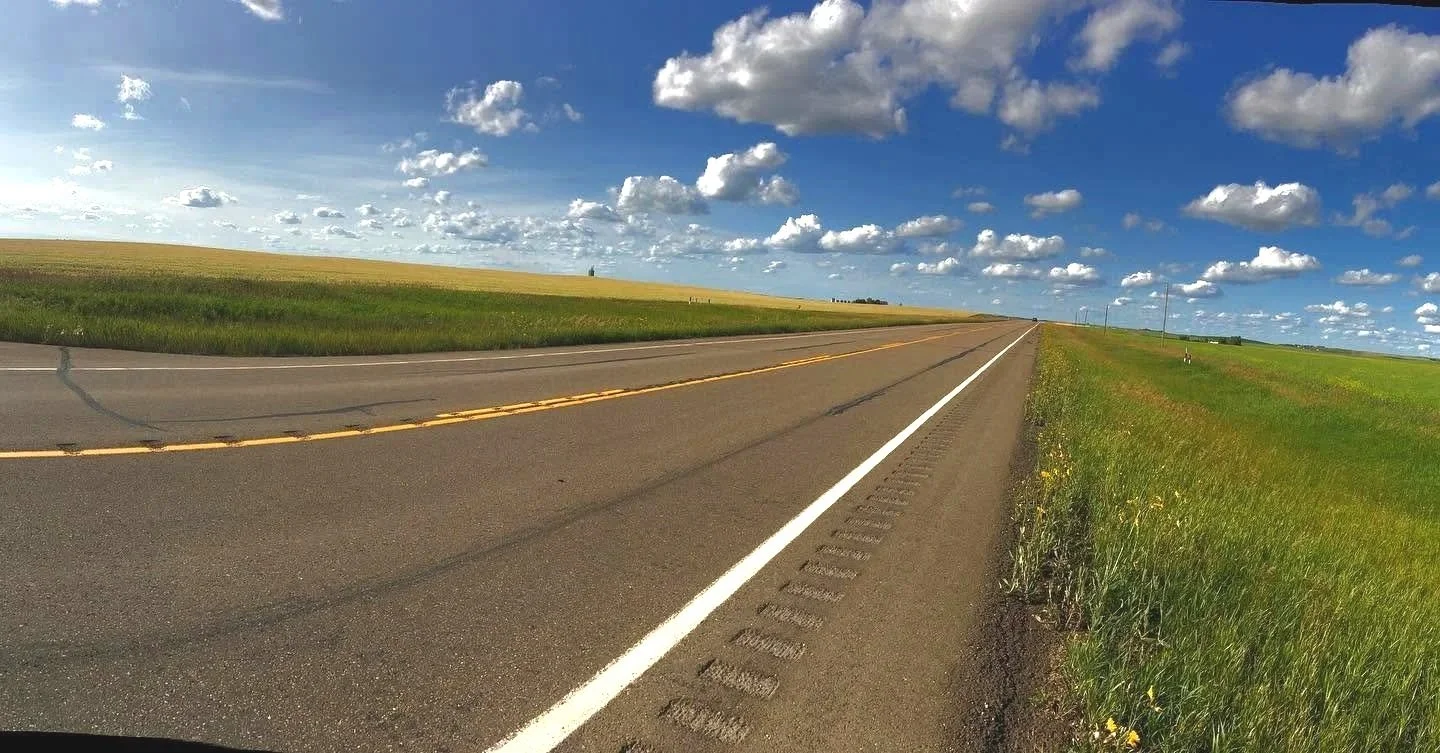
A road in southeastern Alberta. Photo by Shara Cooper
The Canadian Prairie Culture
Prairie culture doesn’t sit apart from the land. It comes from it.
The sky. It’s big. That’s not just a feature for photos. When you live here, it changes perspective. The weather moves across it in full view. You can watch storms build on the horizon, see rain before it arrives, and notice how sunsets take over the entire sky. Space stops feeling abstract and becomes something you live inside of.
The wind is constant. It moves without obstruction across open land, shaping how people build, travel, and even talk about the weather. It carries the smell of rain to you and makes the hot, dry stretches of summer more tolerable.
Towns are usually spaced far apart, connected by long ambling stretches of road. Driving is more relaxing because you can see forever. What would be considered remote in other places is simply part of routine life here. Proximity seems smaller. Driving three hours one way to hike in the mountains is nothing.
Winters are long, cold, and uncompromising. They shape how people plan, how they move, and how communities function.
The Prairies did not begin with settlement or agriculture. They have been home to Indigenous peoples for thousands of years, long before provincial borders or farmland. Nations including the Cree, Saulteaux, Dakota, Dene, and Blackfoot have lived with these grasslands in ways that shaped and were shaped by them, through movement, stewardship, and deep ecological knowledge that predates modern conservation science.
The Prairies in Canadian Literature
Settler and prairie-region writing often returns to weather, distance, isolation, and small communities as structuring forces. W. O. Mitchell, Sinclair Ross, Miriam Toews, Guy Vanderhaeghe, and Gail Anderson-Dargatz all write from different angles and periods, but the prairie landscape appears throughout their work as setting, constraint, and frame for human life.
Another thread of prairie literature comes from Indigenous writers whose work carries different relationships to land, time, and story. Louise Bernice Halfe, Tomson Highway, Lee Maracle, and Gregory Scofield write the Prairies through language shaped by Cree, Métis, and broader Indigenous worldviews. Their work often holds land, memory, language, and history in the same space, with prairie landscapes carrying cultural and spiritual meaning alongside lived experience.
Scandinavian Settlement and the Prairie Landscape
A significant number of Scandinavian immigrants settled on the Canadian Prairies in the late 19th and early 20th centuries, particularly in parts of Manitoba, Saskatchewan, and Alberta. Many came from rural regions of Norway, Sweden, Finland, and Iceland during periods of economic pressure, population growth, and limited land availability in their home countries. Historical accounts and settlement records show that some of these newcomers noted similarities between the prairie landscape and the open agricultural and forest-edge regions they had left behind. The resemblance was not exact, but the scale of open land, seasonal extremes, and reliance on farming and resourcefulness in harsh winters created points of familiarity.
In Canada, Scandinavian settlers often established farming communities in areas with mixed agricultural potential — transition zones between prairie grassland, parkland, and forest. These environments supported both grain farming and livestock, practices that aligned with agricultural traditions many brought from northern Europe. Over time, Scandinavian-Canadian communities contributed to prairie development through cooperative farming practices, local institutions, and cultural organizations. Churches, social clubs, and settlement networks played a role in community cohesion in rural areas where isolation and distance shaped daily life.
Today, the influence of Scandinavian settlement remains visible in parts of the Prairies through place names, heritage communities, and cultural festivals, reflecting one of many immigrant histories that became interwoven with the region’s development.
Sisu and grit
I sometimes think growing up on the prairies gives people a particular kind of grit. The Finns have a word — sisu. It is stoic tenacity and a definition of their national character. I define it as the strength you find when you don’t have any strength left and I think prairie life has a special way of building sisu.
So what are the prairies? For me … they are home.